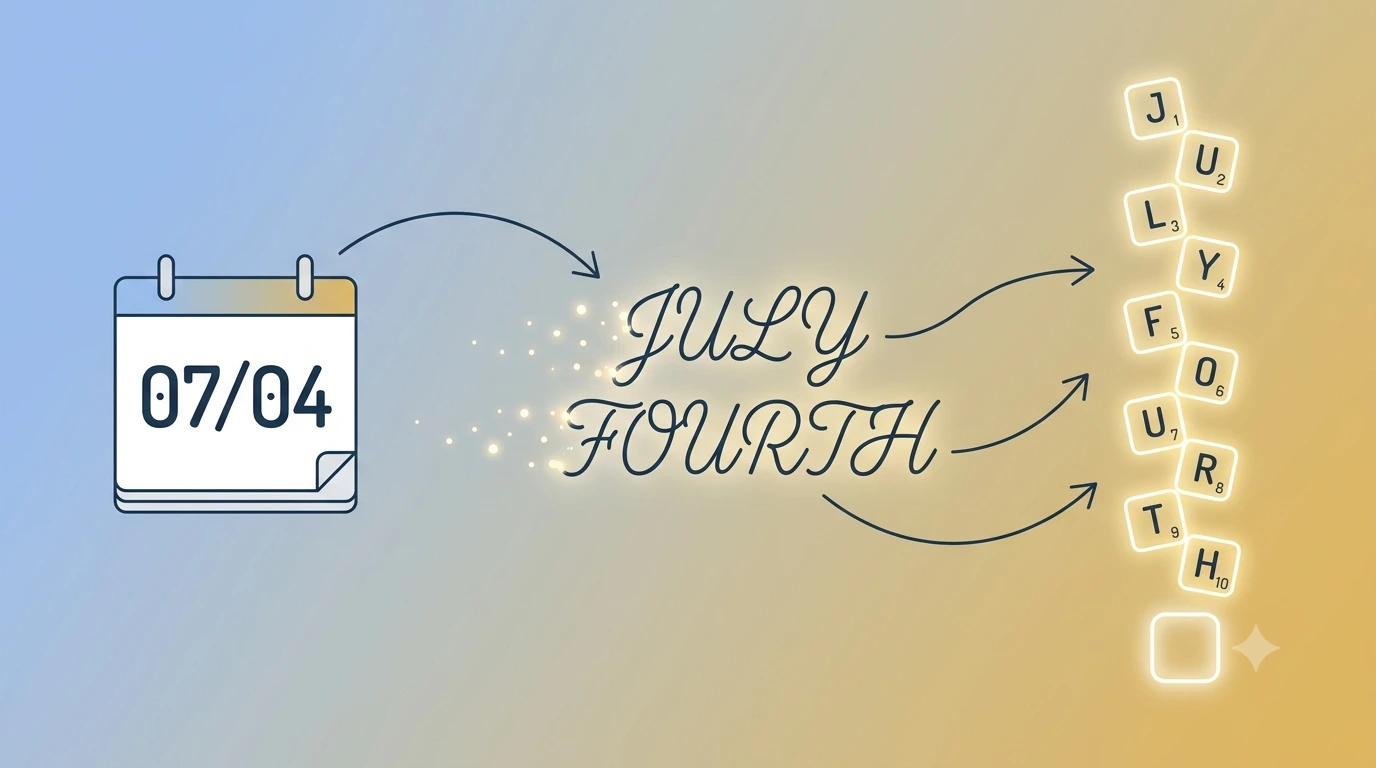
Feed “12/25/1990” straight into a gematria calculator and it comes back blank — not because the tool is broken, but because every gematria cipher reads letters, not digits. Dates need one extra step before they’ll produce a number at all, and almost nobody explains that step out loud.
Why Numerals Break Every Gematria Cipher
A cipher assigns values to letters of the alphabet. Feed it a digit and there’s nothing to assign — the character just gets stripped and ignored, the same way spaces and punctuation get stripped. That’s true whether you’re running Ordinal, Jewish, or any of the other systems.
So a birthday has to become words before it can become a number. “March 3rd, 1995” turns into “March Third Nineteen Ninety Five” — and that phrase, not the original numerals, is what actually goes into the calculator.
Turning a Date Into Something a Cipher Can Read
Start by writing the date out completely, the way you’d spell it on a formal document. “5/17/1988” becomes “May Seventeenth Nineteen Eighty Eight.” No shortcuts, no digits sneaking back in.
From there you’re choosing how much of the date to include, and no option outranks another — you’re just committing to one:
- Month and day only: “May Seventeenth”
- Full date with year spelled as a number: “May Seventeenth Nineteen Eighty Eight”
- Year spelled digit-by-digit instead: “May Seventeenth One Nine Eight Eight”
Whichever version you pick, run it through a calculator built to check all six cipher systems in one pass — Ordinal, Reduction, Jewish, and the rest — instead of guessing which one applies to dates. None of them are date-specific; they’re the exact same six systems that process any other word or phrase.
Where the Numbers Actually Diverge
Take “July Fourth.” Stripped to letters, that’s J-U-L-Y-F-O-U-R-T-H. Under Ordinal, where A=1 and Z=26, those letters total 156 — J is 10, U is 21, L is 12, Y is 25, F is 6, O is 15, U again 21, R is 18, T is 20, H is 8.
Run the same ten letters through Jewish gematria and the total jumps to 1,664. J alone accounts for more than a third of that number — 600 points for one letter, versus 10 points under Ordinal — which says more about why these two systems produce wildly different totals than any general explanation could. The mechanics behind why Ordinal and Jewish totals never match are worth understanding before you compare a date’s value to anything else.
The Two Reasons People Bother With This
Two motives account for nearly every date-gematria search. One is personal: checking whether a birthday, wedding date, or anniversary lines up numerically with a name that matters. The other borrows directly from how corners of the gematria community treat public events — spelling out the date of something newsworthy and checking its total against related words, the same habit behind viral claims tied to numbers like 666, 144, or 322.
Either motive runs through the identical three moves: spell it out, settle on a cipher, calculate. Nothing about the process changes based on why you’re doing it.
The Three Mistakes That Wreck a Date Calculation
Leaving numerals in the input tops the list — “1990” contributes zero to any total unless it’s spelled “Nineteen Ninety” first. Right behind it: switching spelling styles mid-comparison, since “Fourth” and a half-spelled “4th” won’t calculate to the same number even though a person reads them as identical.
The third mistake is assuming a dedicated “date cipher” exists somewhere. It doesn’t — dates run through the same six systems as names, phrases, and anything else made of letters. Once a date is spelled out, it’s just text, and gematria has never treated text differently based on what it originally represented.
Pick a birthday you’re curious about, spell it two different ways, and watch how much the total shifts before you draw any conclusion from it.