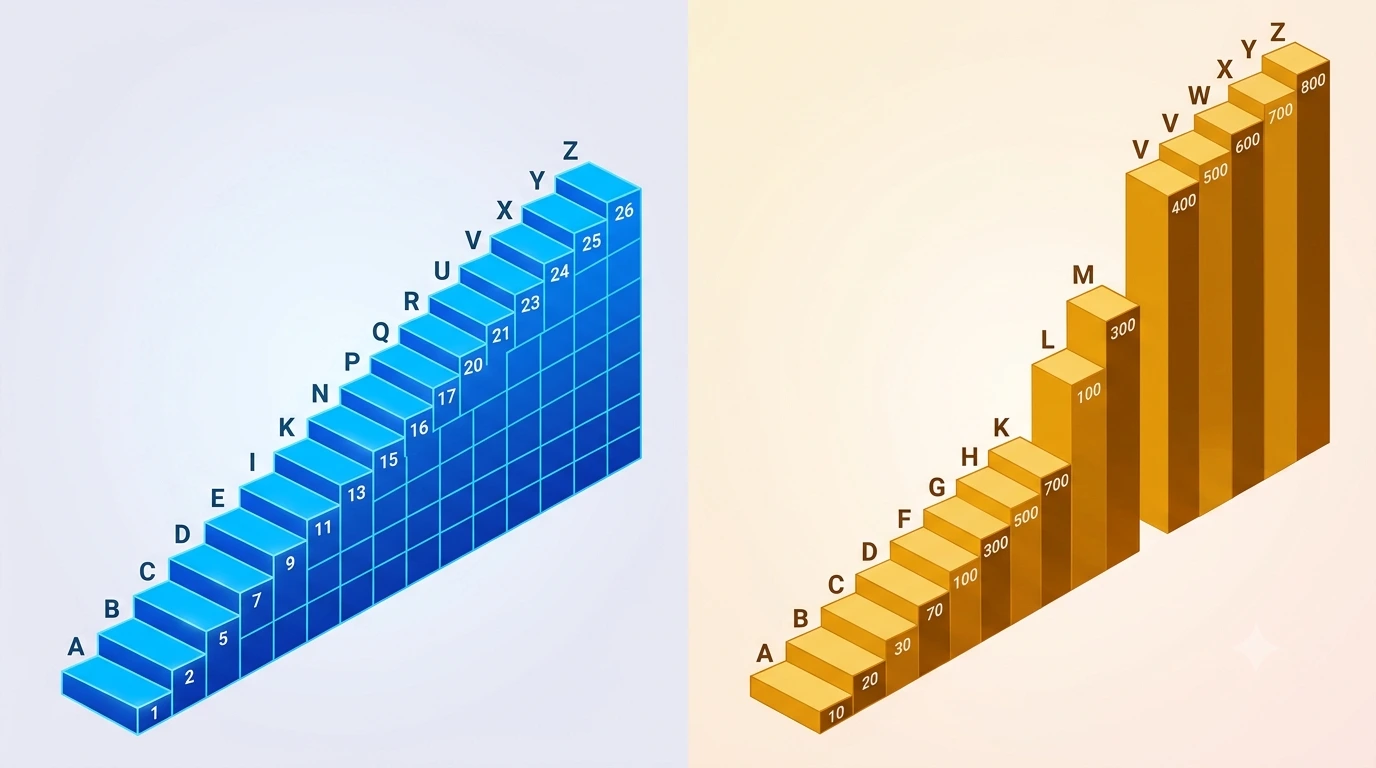
Type the same word into an Ordinal and Jewish gematria calculator side by side, and one total can land nine times higher than the other before you’ve finished reading them. That’s not a glitch — Ordinal gematria and Jewish gematria are two separate counting systems producing exactly what they were built to produce.
What Is Ordinal Gematria? Every Letter Gets Its Alphabet Rank
Ordinal gematria is the plainer of the two systems. A gets 1, B gets 2, C gets 3, climbing one digit at a time until Z lands on 26. Add up a word’s letters and that sum is the Ordinal total — arithmetic anyone can check with fingers and a scrap of paper, no Hebrew tradition or numerology lineage required.
What Is Jewish Gematria? It Borrows Hebrew’s Escalating Scale
Jewish gematria throws out the “one letter, one step up” rule. It copies the block structure used in traditional Hebrew gematria — assigning numerical values to letters so a word can be read as a number — and stretches that same escalating pattern over the English alphabet instead of counting up letter by letter.
A through I still run 1 through 9, matching Ordinal gematria exactly. Past that point the math splits hard: K jumps straight to 10, L to 20, M to 30, and by the time you reach V, W, X, Y, Z, single letters carry hundreds of points each. Ordinal never climbs past 26 no matter which letter you’re holding; Jewish gematria can hit 800 on one letter alone.
Ordinal vs Jewish Gematria Example: The Name “Max”
Run the letters one at a time.
- Ordinal gematria: M=13, A=1, X=24 → total: 38
- Jewish gematria: M=30, A=1, X=300 → total: 331
Same three letters. X alone did nearly all the damage — 24 points under Ordinal, 300 under Jewish. When a gematria gap looks unusually wide, check the word for a late-alphabet letter first; nine times out of ten, that’s the culprit sitting in plain sight. If you want to see this same kind of divergence play out between two different words, comparing two names side by side makes the pattern even easier to spot than a single word does.
Ordinal or Jewish Gematria: Which One Should You Use?
Pull up Ordinal gematria when you need a number a ten-year-old could verify by hand — teaching gematria for the first time, settling a quick argument over two short words, or running puzzles where speed beats tradition.
Pull up Jewish gematria when you’re cross-referencing numerology forums or archives that specifically cite “Jewish gematria” values, since that label shows up constantly in those threads and Ordinal numbers won’t match what’s posted there. That’s also the cipher behind most viral number claims — if you’ve ever seen someone attach meaning to 666, 144, or 322 turning up in a name, that’s almost always a Jewish gematria total doing the work, not an Ordinal one. The tool you reach for should follow the source you’re checking against, not the other way around.
Why You Should Never Compare Ordinal and Jewish Gematria Totals Directly
Comparing an Ordinal total to a Jewish total is the mistake that trips people up more than any confusion over the underlying math. If two words share an Ordinal number, that’s a genuine link inside one system. If one word’s Ordinal number happens to match a different word’s Jewish number, two unrelated calculations landed on the same digit by chance — nothing more, no matter how tempting the coincidence looks.
How to Check Ordinal and Jewish Gematria at the Same Time
A calculator that labels every cipher separately, instead of defaulting to one and burying the rest, is the only reliable way to catch that distinction before it trips you up. Check a word against both systems at once and look at which other words share its number before you build any theory on a match.