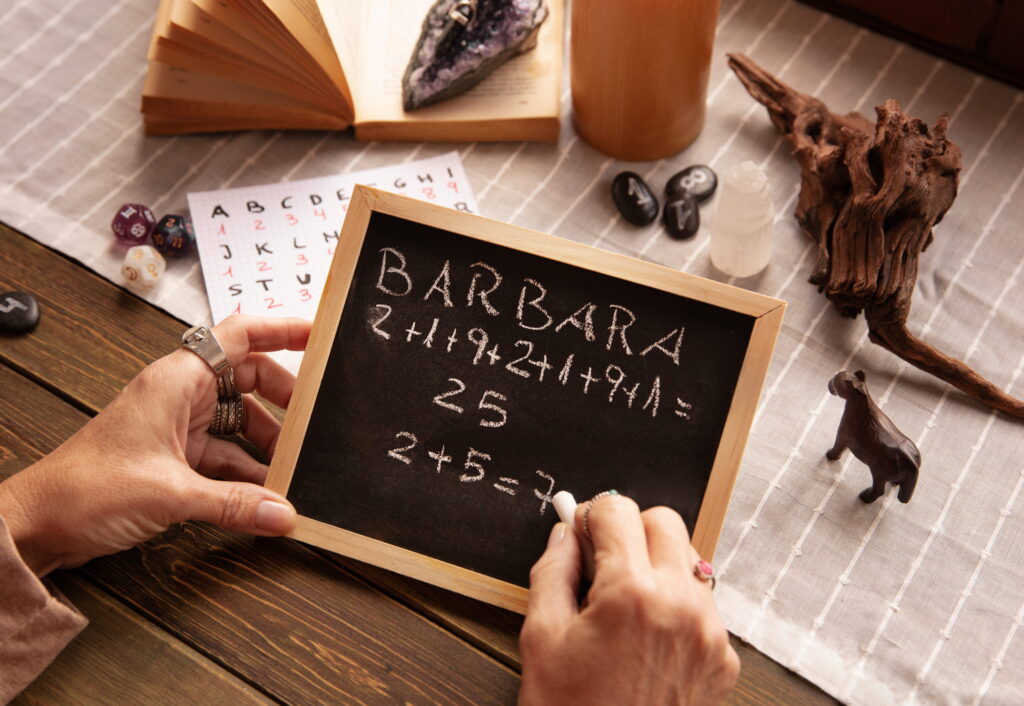
Curious what your name says about you? Name numerology is one of the most searched paths into self discovery numerology, and most people find their way in through a name number calculator or by exploring Chaldean numerology, one of the oldest and most respected numerology systems still used today.
In this post, we’ll cover what name numerology actually is, where Chaldean numerology comes from and how it differs from other systems, how a name number calculator turns your name into a meaningful number, and what each final number actually means once you have it.
What Is Name Numerology?
Name numerology is the practice of assigning a numeric value to each letter in your name, then adding those values together to reveal insights about your personality, strengths, and life path. It’s based on the idea that names carry vibrational energy, and that energy can be translated into numbers that are easier to interpret and compare.
People turn to name numerology for a lot of reasons. Some want a quick personality snapshot, similar to a horoscope. Others use it before naming a child, choosing a business name, or even deciding whether to legally change their own name. Because a name is something we hear and use every single day, numerologists believe it has a lasting influence on how we experience the world and how the world responds to us.
Most name numerology readings focus on a few core numbers, each pulled from a different part of your name:
- Destiny/Expression Number: calculated from your full birth name, said to reveal your life purpose and natural talents
- Soul Urge Number: calculated from the vowels in your name, said to reveal your inner desires and motivations
- Personality Number: calculated from the consonants in your name, said to reveal how others perceive you
Each of these numbers is meant to reveal a different layer of who you are, from your outward personality to your inner motivations. Together, they form a more complete numerology profile than any single number could offer on its own.
Where Chaldean Numerology Comes From
While the Pythagorean method is the most common numerology system used online today, Chaldean numerology is actually much older, tracing back to ancient Babylon and the Chaldean civilization, long before Pythagoras developed his own system in ancient Greece. Because of its age, many traditional numerologists consider it the original numerology system, and some believe it carries a more authentic, spiritually accurate reading.
The core difference between the two systems comes down to how letters are assigned numbers.
Pythagorean numerology assigns numbers in simple alphabetical order. A is 1, B is 2, C is 3, and so on, cycling back to 1 after 9. It’s straightforward, which is part of why it became the standard for most online calculators.
Chaldean numerology works differently. Instead of following alphabetical order, letters are grouped according to the sound and vibration they produce when spoken. Because of this, the number assigned to a letter isn’t predictable just by knowing its position in the alphabet, you have to reference a Chaldean chart. Chaldean numerology also only uses numbers 1 through 8. The number 9 is considered sacred and is intentionally left out of standard calculations, only appearing in special circumstances.
Here’s a side by side comparison:
| Pythagorean | Chaldean | |
|---|---|---|
| Letter values | 1 to 9 in alphabetical sequence | 1 to 8 based on sound vibration |
| Number 9 | Used in calculations | Considered sacred, excluded from calculations |
| Origin | Ancient Greece | Ancient Babylon |
| Calculation basis | Alphabetical position | Sound and vibration of each letter |
| Reputation | Simpler, more common online | Considered more precise by traditional numerologists |
Because the two systems assign values so differently, it’s common for the same name to produce two completely different final numbers depending on which system is used. Neither is “more correct” in an objective sense, but many long time numerology practitioners lean toward Chaldean numerology for deeper or more serious readings, while Pythagorean numerology remains popular for quick, casual results.
How a Name Number Calculator Works
A name number calculator automates this entire process so you don’t have to do any manual math. Instead of mapping each letter yourself and adding everything by hand, you simply type in your full name and the calculator does the rest. Here’s what happens behind the scenes, step by step:
- Each letter is converted to a number based on the chosen system, either Pythagorean or Chaldean
- All the numbers are added together to get a total sum
- The total is reduced by adding its digits together repeatedly until you reach a single digit, unless the result is a master number like 11, 22, or 33
- The final number is interpreted based on established numerology meanings for that number
For example, using the Chaldean system, a name might add up to 47. That reduces to 4 plus 7, which equals 11. Since 11 is considered a master number, it’s typically left as is rather than reduced further to 2, because master numbers are believed to carry heightened spiritual significance.
This is exactly what makes a name number calculator so useful. It removes the guesswork and manual math, letting you instantly see your number and what it traditionally represents, without needing to memorize letter charts or reduction rules yourself.
What Your Final Number Actually Means
Once your name number calculator gives you a result, the next natural question is what that number represents. While full interpretations can get detailed, here’s a general overview of what each core number is traditionally associated with:
- 1: Leadership, independence, and ambition
- 2: Cooperation, diplomacy, and sensitivity
- 3: Creativity, self expression, and communication
- 4: Stability, discipline, and hard work
- 5: Freedom, adaptability, and change
- 6: Responsibility, nurturing, and harmony
- 7: Introspection, wisdom, and spirituality
- 8: Power, ambition, and material success
- 9: Compassion, idealism, and humanitarianism
- 11: Intuition and spiritual insight (master number)
- 22: The master builder, large scale achievement (master number)
- 33: Selfless service and healing (master number)
These meanings apply whether the number comes from a Pythagorean or Chaldean calculation, though the number you actually land on may differ between the two systems, which is exactly why so many people end up trying both.
Why People Search for Both Name Numerology and Chaldean Numerology
A lot of people start out searching simply for “name numerology,” get a basic result from a Pythagorean calculator, and then discover that different systems, like Chaldean numerology, can produce an entirely different number. That’s usually the moment the search shifts specifically to Chaldean numerology, since it’s viewed as a deeper, more traditional, and in many practitioners’ eyes, more accurate method.
If you’ve already tried a standard name numerology calculator and want a second, more traditional perspective, running your name through a Chaldean numerology calculator is a natural next step. Comparing both results side by side can also be genuinely interesting, since it often highlights different facets of the same underlying personality.
Try It for Yourself
If you want to see how your own name translates into numbers, you can explore our calculators and compare results across systems. Pairing a name number calculator with a Chaldean numerology calculator gives you a fuller picture, one rooted in simplicity and modern popularity, the other in centuries of tradition and symbolic depth.
And if you’re also curious how gematria fits into all this, our [Gematria Calculator] uses a related but distinct method rooted in Hebrew tradition, giving you yet another lens to explore the numbers behind names and words. Between name numerology, Chaldean numerology, and gematria, there’s no shortage of ways to see what your name might really be saying about you.
Frequently Asked Questions
Is Chaldean numerology more accurate than Pythagorean numerology? Accuracy is ultimately a matter of belief rather than something provable. Many long time numerologists consider Chaldean numerology more precise since it’s based on letter sound vibration and predates the Pythagorean system by centuries.
Why does my name number calculator give a different result each time? Usually because the calculator switched between Pythagorean and Chaldean systems, or because your name was entered differently, such as including a middle name in one attempt and not the other.
Should I use my birth name or my current name in a name number calculator? Traditional numerology typically uses your full birth name, since it’s believed to hold your original vibrational imprint. Many people also calculate their current legal name for comparison, especially after a name change or marriage.
What is a master number in name numerology? Master numbers are 11, 22, and 33. When a calculation reduces to one of these, it’s left unreduced rather than simplified further, since these numbers are believed to carry stronger spiritual significance.
Can two different names have the same number? Yes, this happens often. Since both systems reduce every name down to a single digit or master number, it’s common for entirely different names to land on the same result.
Is name numerology the same as gematria? No, though the two are related. Name numerology focuses on personality and life path analysis, while gematria, rooted in Hebrew tradition, is used to find numeric equivalences between words and phrases.